
In crisis, justice does not wait, Brigitte Chelebian tells Human Rights Council
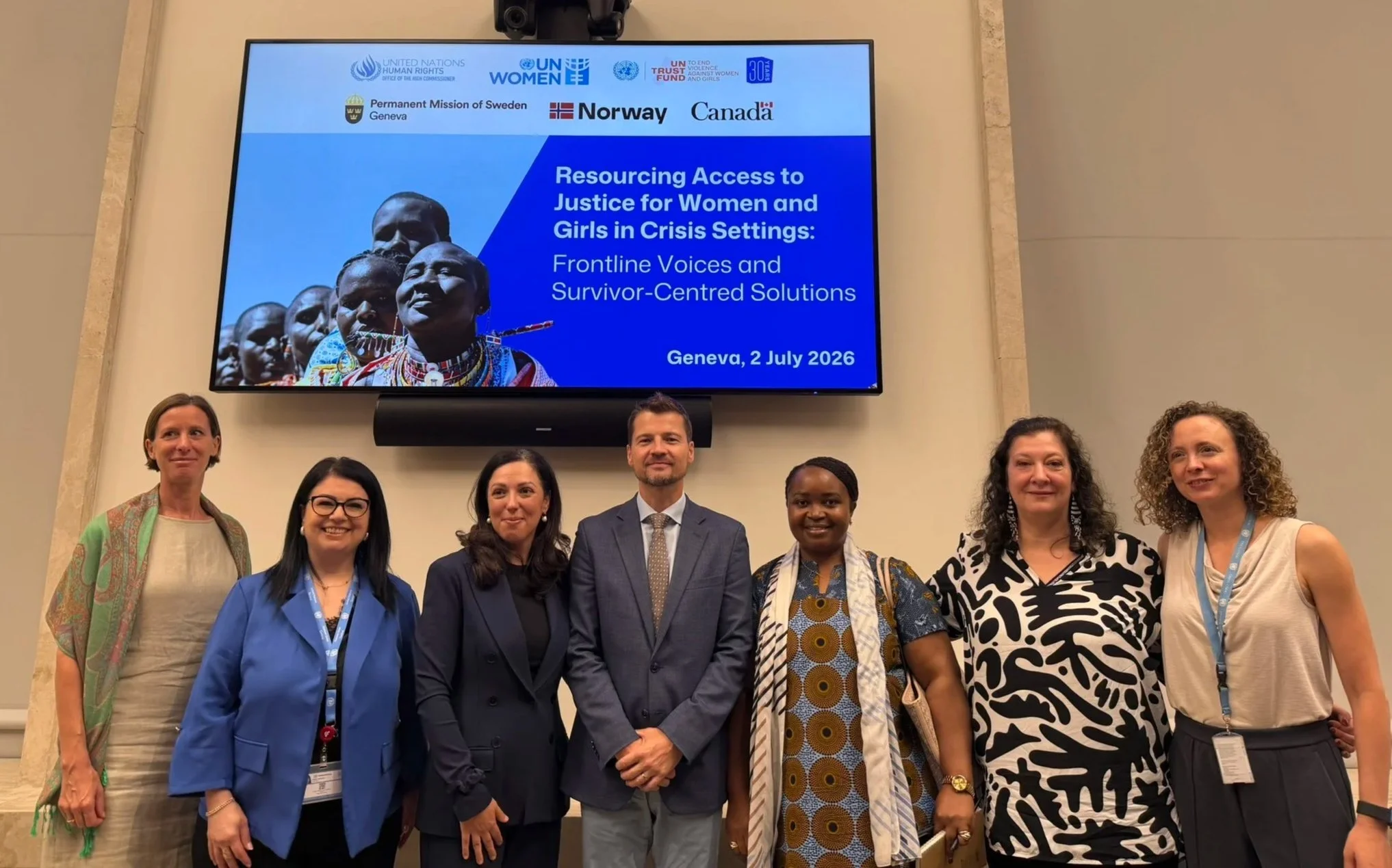
Panellists at the side event Resourcing Access to Justice for Women and Girls in Crisis Settings, today at the Human Rights Council in Geneva. Photo: UN Trust Fund
Women and girls experiencing crisis cannot be made to wait for justice, leading women’s rights activist told the UN Human Rights Council.
Speaking at a side event during the 62nd Session of the Human Rights Council, Brigitte Chelebian of Justice Without Frontiers (JWF) in Lebanon said that crisis adds yet another barrier to women and girls from accessing justice, who already face struggles from patriarchal attitudes and institutions, discrimination under the law, and a lack of knowledge of legal processes.
Brigitte outlined the practical approach her organization has taken to address these challenges, ensuring that if women and girls cannot access justice, then steps must be taken to bring justice to them. Through the support of UN Trust Fund and Karama, JWF has established a nationwide network of community paralegals across Lebanon, developed innovative mobile legal service initiatives, and successfully integrated legal awareness into humanitarian response programs.
The work Brigitte describes demonstrates what can be achieved by supporting local women’s rights organisations, and how they can open up access to justice, even to the most marginalized communities.
Read Brigitte’s full intervention below.
Brigitte Chelebian, Founder and Director, Justice Without Frontiers (JWF), Lebanon, speaking at the 62nd Session of the Human Rights Council, Thursday, 2nd July
During the COVID-19 pandemic, a woman called me after she and her children had been beaten by her husband. As a lawyer, I explained about the legal process we can follow.
She refused.
She told me: “Today, I need food for my children. Maybe if food is secured, the violence will decrease.”
Her response was a painful and dangerous indicator, for many women struggling to survive, justice is no longer perceived as a priority. From that day forward, our question changed. We stopped asking: How can women access justice? Instead, we asked: How can justice reach women?
Lebanon is a country of remarkable diversity, but also profound legal complexity. We have eighteen recognized religious communities and fifteen different personal status codes.
For many women and girls, justice remains fragmented, unequal, and deeply shaped by social, economic, and religious realities.
Over the past years, Lebanon has endured successive crises: the COVID-19 pandemic, the Beirut Port explosion, severe economic collapses, and the wars of 2025 and 2026. In 2026 alone, at least 4,247 people were killed, more than 12,000 injured, and over 1.2 million displaced.
Women and girls have paid the highest price. The barriers preventing women from accessing justice remain enormous. Many women and girls are still unaware of their rights and of the mechanisms available to seek protection.
Justice has become so expensive that, for many women and vulnerable groups, it is increasingly treated as a luxury rather than a right. Trust constitutes another major challenge. Building confidence between communities and institutions requires time, transparency, accountability, and sustained engagement.
Patriarchal norms within personal status laws continue to limit women’s rights and participation at all levels of society. For many women, access to justice is not only about accessing courts, but also about overcoming structural barriers that affect their everyday lives.
At Justice Without Frontiers, our response has been simple:
If women and girls cannot reach justice, justice must reach them. Through the flexibility of our three-year partnership with the UN Trust Fund, implemented in cooperation with Karama,we established networks of community paralegals across Lebanon, we developed innovative mobile legal services , we succeeded in integrating legal awareness into humanitarian responses, we further introduced mediation , we developed curriculum for internal security forces, drafted policy paper and draft law on bullying.
Justice Without Frontiers works closely with ministries, judges, bar associations, security institutions, municipalities, social workers, journalists, youth groups, civil society organizations, relogious leaders, political parties.beccause believe that civil society cannot work alone to ensure access to justice but side by side with governments and public institutions.
Yet much remains to be done.
Throughout every crisis Lebanon has endured, women-led organizations have remained on the front lines. They preserved trust, defended rights, supported survivors, and ensured that women and girls were never forgotten.
Today, one of their greatest challenges is sustaining both their services and their mission.
Budget cuts, backlash against women’s rights, shrinking civic space, and recurring emergencies continuously force organizations to shift from long-term transformative work toward short-term emergency responses.
And despite all these challenges, one lesson remains clear:
Justice cannot wait until a crisis ends.
Justice is not a luxury.
Justice is not what comes after humanitarian assistance.
Justice is protection, dignity, prevention, and accountability and a core pillar of humanitarian assistance.
Jutice is the foundation of peace, security, and sustainable development .
Women affected by violence should never become numbers in reports or humanitarian statistics.
Behind every figure is a woman protecting her children, a survivor rebuilding her life, a girl searching for safety and dignity, or a leader driving change within her community.
Truly transformative programmes are those that adopt a holistic approach, strengthen institutions, empower communities, build trust, and ensure that protection and support continue long after a project officially ends.
Imagine a survivor of technology-facilitated violence, sexual violence, or domestic abuse reaching out to an organization that has supported her community for years, only to hear:
“We no longer have funding. We are waiting for donors. This issue is no longer a priority.”
What message are we sending to her?
That ending violence must wait for funding cycles?
That rights depend on annual priorities?
That protection can be paused?
Justice requires continuity.
Justice requires trust.
And systemic transformation requires long-term, flexible, predictable, and locally led-investment.
Our experience with the UN Trust Fund demonstrated that flexibility is not an operational tool—it is protection in itself. It enabled us to adapt during conflict, remain accountable to communities, and continue supporting women and girls when they needed us most.
Justice is not a personal matter, it is the responsibilities of all of us.
My message today is simple:
Because there can be no peace without justice, no security without accountability, and no sustainable development without the rule of law.
We must trust women’s rights organizations and women-led organizations, and invest in their locally led, evidence-based solutions through long-term, flexible, and core funding.
This is not only a financial commitment, it is a global responsibility and a collective accountability toward every woman and girl.
Because justice does not wait.
Thank you.