
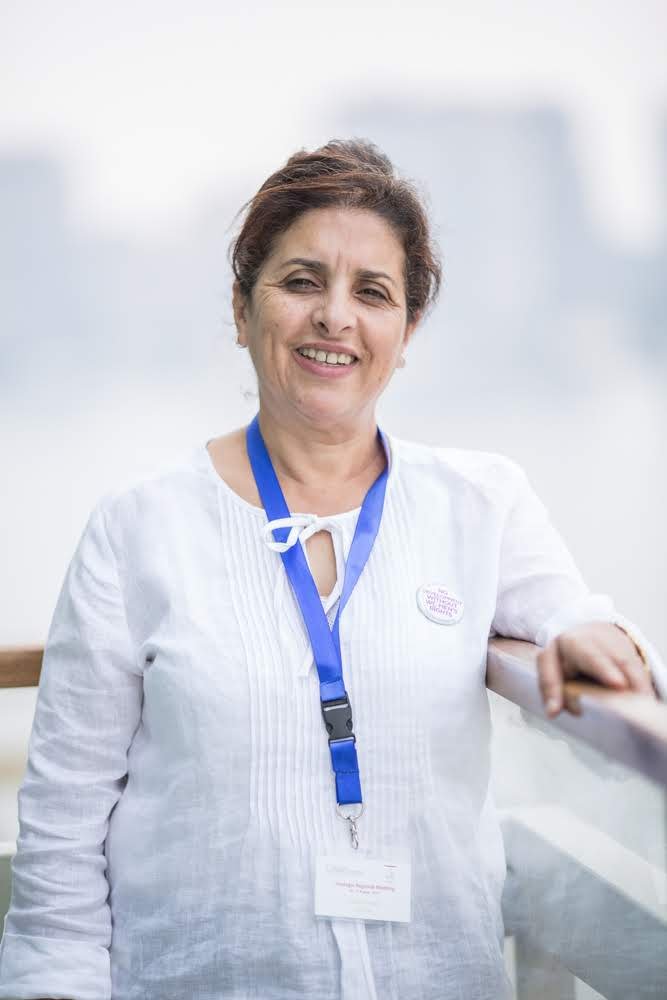
Fatima Outaleb
Fatima’s work has developed from community-based work with survivors of violence to working on policy and advocacy at regional level.
I work with Union Action Feministe, a women's rights NGO that was founded in 1987, and which has brought into view many issues pertaining to women's rights.
My involvement in Karama goes back to 2005, a very long journey. I can proudly say that I have been one of the co-founders of Karama, and that it was a turning point in my career as an activist.
From national activism to Karama’s regional network
Coming from Morocco and then moving to work at regional level, that was the door that has opened up to me. It was a door that led me to meet many brilliant activists, but also challenges. I had the opportunity to face and see how women struggle on a daily basis to change and reform laws, but also to survive and exist. It is a journey, it is a long journey that is part of my history.
In 2005, I was quite young, and working mainly nationally. I remember when Karama, really when Hibaaq and other people who were founding in Karama, came to Morocco to meet us, because that was how it started. We met each other, and we just felt that there is potential work that should be done with those ladies. They were carrying a message that was new to us, new to me. I felt that Hibaaq, coming from Africa, with this double identity - speaking Arabic, speaking Somali, and really speaking about the issues that were appealing to me, not just to me, but to us, because they belong to an institution.
Karama came to us with no conditions, with hope, with a dream. It is amazing that we are still here, sustainable work, consistent work, but also human relationships. Karama is not just an institution, a network where we strategize, we work, we discuss, we lobby, we show solidarity, but it’s also an environment that is full of understanding and humanity.
I was telling Hibaaq recently, we could write something, a novel perhaps, something that shows how things have evolved - good things, bad things. We lost our colleague Salwa, we lost on many fronts, how for example, Amal from Yemen, was heading a very big NGO, and in a very short time she became a refugee. But still Karama is surviving, and still Karama is on the ground, still working with the same people, with more young people, with other people, but still the same core. And this sustainability is unique. It is unique in Karama, and that's why it’s a home.
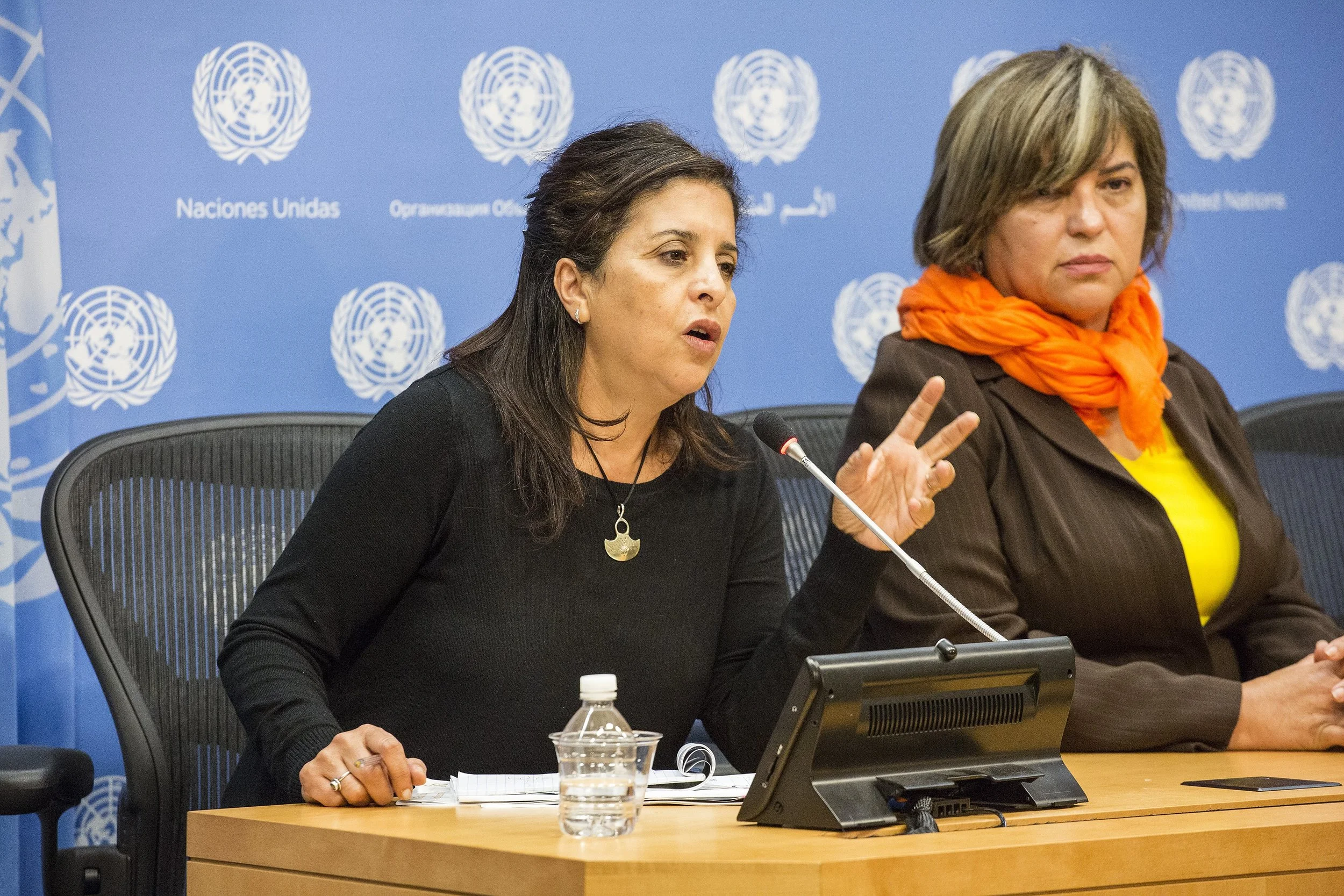
Building regional solidarity
Karama is another home. It is our home.
To bring together women from across our region, these women who are part of Karama. We share a lot. We have a lot of commonalities and a lot of issues, the same suffering, same struggles. It's true that it differs from one country to another. There are countries where, for example, wars are declared and people were displaced - our colleagues in Karama were displaced. But that doesn't mean that we are not affected by that.
When it happens that war is taking place in different parts of this region, the impact is regional or even global. You are at a certain point, you are in your safe zone, and suddenly you have war in Syria. We lost many friends from Syria. Some of them never came back, but others stayed, and we had to accommodate the program, the strategies and the priorities. First of all, we had to survive but we also had to stand on the side of our friends and maybe shift our priorities.
We started working on peace and security. I remember when we started Karama, it was more focused on gender-based violence. But then, from 2011 on other priorities emerge because other problems emerge. So we have accommodated the programs. We have accommodated the strategies in a way to really respond and face and address the emerging issues. We change and we adapt to the situation.
What is different with Karama is that even when you have people coming from very tough environments, from conflict areas. As soon as we meet each other on different platforms, we create an environment that drives hope to them. And it's amazing how Salwa, for example, who was assassinated in Libya, we worked together in the month before she was killed. She was really hoping to change, and she was invested in that election and democracy.
I have been part of other groups. Unfortunately, it happens that sometimes the atmosphere or the environment is not always in favor of positive, friendly work. But in Karama, people are used to adapting the tools, the strategies, the behavior, the attitude in a way to create that positive atmosphere that inspires us to move on to work.
This is our identity in Karama. And it's true, believe me, as soon as we get to meet, everything changes, we become different. We become very lively, and we become very motivated to work together, and that's good. This is me. This is how I feel. They know me, I'm very vocal when I don't like things or when I don't agree, I'm very vocal. I don't like hypocritical attitudes, and I say what I think. And it doesn't mean that we are all speaking the same language. But there is room in Karama because you have inspiring people leading like you. Believe me, people who can respond to you in every situation. You forget about some turbulence. If there are some turbulences, because the general atmosphere allows for certain positivity.