
Honor Salwa Bugaighis by Ending Impunity
Activists gathered online to mark the sixth anniversary of the assassination of Salwa Bugaighis last week in a discussion on the need to end impunity.
The event saw contributions led by Salwa’s sister, with friends and colleagues from across the Arab region, alongside experts and activists working on the women, peace and security agenda.
Six years after Salwa’s murder in Benghazi, there has been no serious, independent investigation into her killing and the abduction of her husband, Essam al-Ghariani.
Under the banner that ‘Justice for Salwa is Justice for All’ activists have continued to demand accountability for the crimes committed during the conflict and instability in Libya.
The event was opened by Hibaaq Osman, who discussed the long campaign to demand justice for Salwa.
Hibaaq cited the impact that Black Lives Matter has had in focusing attention on and challenging long-running, systemic injustice as an inspiration for those determined to end impunity.
Iman Bugaighis spoke of her sister’s hopes for Libya, of her legacy, and the duty we all have to protect human rights activists.
“What made Salwa so unique was that she was coherent, consistent, transparent, and genuinely committed to democratic dialogue”
Many members of the Dutch parliament continue to be dedicated to the movement for justice for Salwa.
The event welcomed a video message from Andre Bosman, member of the Dutch parliament’s Foreign and Defense committees, as well as a personal message from Martijn van Helvert.
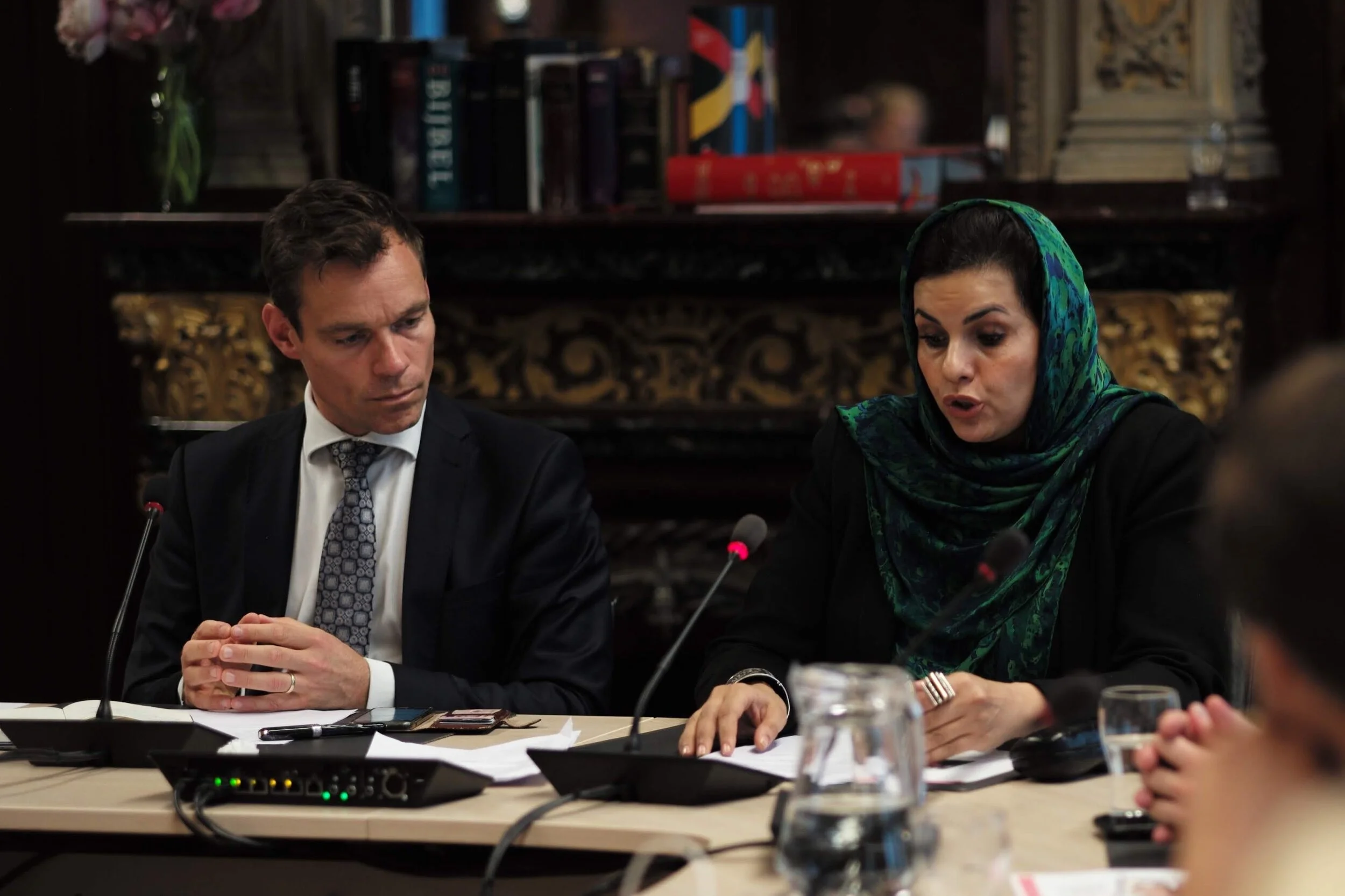
Martijn van Helvert, alongside Zahra’ Langhi, at the Justice for Salwa event in The Hague in 2019
“Last year we gathered in the chambers of the Christian- Democratic Party in the Dutch Parliament on the 25th of June.
“We are now gathering online but the message is unchanged: we honour and cherish the memory of Salwa Bugaighis.
“Amidst war and terror she dared speaking out against militias, for disarmament, encouraging youngster to VOTE peacefully.
“And I know that all of you are continuing her strive; you Suzan are doing this in KRG, Amal in Yemen, Zahra in Libya -the same goes for all of you gathered in this online commemoration.
“The pain of this horrible, cruel & unjust loss is heard to bear. For all of you; family and colleagues.
“Please know that she also deeply inspired us, Members of the Dutch Parliament and that we remember her.
“We will not rest until justice will be done!”
Zahra’ Langhi was, alongside Salwa, a co-founder of the Libyan Women’s Platform for Peace. Zahra’ spoke of the campaign’s wider focus on ending impunity for violent and conflict-related crimes in Libya. She noted that the campaign has always been that justice for Salwa must mean justice for all, or violence will be perpetuated. That is what has happened, with many more women in Libya being silenced with no accountability.
Zahra’ emphasised that the demand for justice has been and must always be inclusive of cases like those of Fariha al-Berkawi, Intisar Al-Hasari, Seham Sergiwa, the women of Tarhuna, and many more victims and survivors.
Mouna Ghanem came to know Salwa thorough her own activism for peace in Syria. Mouna discussed the symbolic nature of Salwa’s assassination, an attack on the principles that Salwa and women like her across the region hold dear.
Patricia Viseur Sellers, jurist and expert in international criminal law, told the discussion that activists needed to look beyond the traditional framework of the women, peace and security agenda to end impunity. Patricia reminded the discussion that much of international law is structured around protection of citizens and civilians - and this is essential when considering accountability.
Jacqueline O’Neill, Canada’s first Ambassador for Women, Peace and Security, noted that there were no consequences for countries failing to implement UNSCR 1325. Amb. O’Neill also noted the inspiration offered by the Black Lives Matter movement to highlight and address injustice in the world.
Yemeni human rights campaigner Amal Basha spoke of the need to protect the lives of peace activists who are in danger. She noted that peace activists in Yemen are often accused of being unpatriotic, of being motivated by politics rather than peace.
Amal said that “we cannot talk about justice and accountability if we allow the war to continue.”
Randa Siniora, of the Women’s Center for Legal Advice and Counselling highlighted the gendered impact of the arms trade and militarization - factors common to Libya, Palestine and a number of other countries in the region. Randa said that it is “we who are paying the price for this as women and girls in our societies”.