
Arab Feminist Network & Karama Position Statement and Recommendations for CSW70
As women’s rights activists, multilateral institutions, governments and other interested parties gather online and in New York for the 70th Commission on the Status of Women (CSW70), Karama and the Arab Feminist Network have jointly developed our position paper and recommendations.
The priority theme of CSW70 is access to justice, a vital issue for members of Karama and the Arab Feminist Network. So much of our activism has been on working toward more responsive and gender sensitive judicial institutions, mechanisms and laws. As such we have come together to develop a joint paper. This work has been particularly necessary this year given that a combination of issues - from the processing of visas to the ongoing conflicts in our region - mean that the obstacles to our participation at CSW are greater now than that at any point before or after the pandemic.
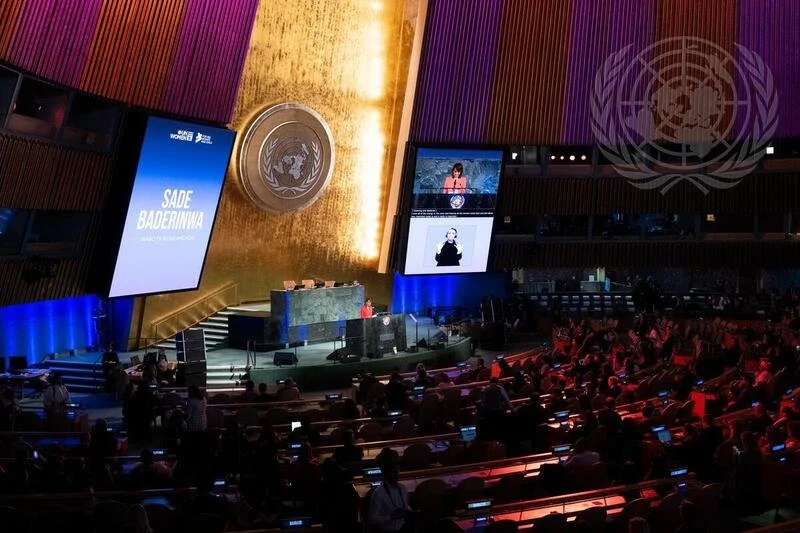
The UN observance of International Women’s Day, on the first day of CSW70. UN Photo/Evan Schneider
Background
The 70th Commission on the Status of Women takes place in a global context of wars, occupation, militarization, economic collapse and climate crisis. Each of these issues affects the Arab region, and the multicrisis has particular impact on this year’s priority theme, women’s access to justice.
The Arab Feminist Network and Karama have consulted with over 100 women from across the Arab region to identify issues and priorities, and make recommendations on access to justice. Our results stress this issue cannot be reduced simply to court procedures. Access to justice encompasses safety, dignity, participation, resourcing and accountability. Policies must then fully address gender equality, peace, disarmament, social protection and justice.
Introduction
Access to justice is a fundamental human right enshrined in international and regional frameworks, and essential for the protection and realization of all human rights. It is also foundational for achieving gender equality and the empowerment of women and girls. Human rights cannot be fully enjoyed if effective remedies are unavailable when violations occur.
Access to justice is a broad concept that includes the ability to obtain fair, impartial, and timely remedies through judicial and non-judicial mechanisms for all forms of discrimination and human rights violations. Across the Arab region, women face entrenched and intersecting barriers that severely limit this access.
Persistent legislative gaps maintain legal discrimination against women, particularly in personal status laws, citizenship and nationality laws, sexual and reproductive health rights, sexual violence and harassment.
In conflict and occupied contexts, access to justice is inseparable from peace processes, ceasefires, recovery frameworks, climate impacts of war, and disarmament measures. The exclusion of women from decisions on security, displacement, detention, reconstruction, and arms control undermines participation, protection, prevention, and recovery, resulting in structural denial of justice.
Prolonged armed conflicts, civil unrest, occupation, increased military spending, debt crises, and the climate crisis further weaken justice systems and exacerbate entrenched structural discrimination. Millions of displaced women and girls suffer from loss of legal identity, land, homes, and livelihood, compounding their exclusion from justice.
Conflict-related sexual violence remains one of the severest and unspoken obstacles to justice. Survivors of rape, sexual torture, forced marriage, trafficking and exploitation during war exist in a world that stigmatises them while offering impunity to their persecutors. Justice, including transitional justice, must therefore be intersectional, including survivor-centred protection, documentation, reparations, and psychosocial support in line with international humanitarian and human rights law.
Technology-facilitated gender-based violence presents an additional and growing challenge for women and girls. There is an urgent need for comprehensive legal responses to address its intersecting impacts.
Customary and informal justice (CIJ) systems continue to prevail as mechanisms for dispute resolution in many communities, especially in rural and tribal areas. While they are often more accessible, less costly, and culturally familiar, these systems frequently prioritize reconciliation and social harmony over rights, disproportionately harming women and girls and reinforcing power imbalances in patriarchal societies where opportunities for women and men are unequal.
This position is grounded in the Beijing Declaration and Platform for Action, CEDAW and its General Recommendations Nos. 30, 33, and 40, and the Women, Peace and Security agenda, applied through an integrated framework that bridges justice, peace, equality, climate justice, and disarmament.
Obstacles to women’s access to justice in the Arab region:
1. Legislative Obstacles
Discriminatory1. laws across the region reflect deeply entrenched patriarchal norms and biases. Despite some national reforms, discrimination persists, notably in family and nationality law, property and inheritance rights, contractual capacity, access to credit, and sexual and reproductive health. Responses to gender-based violence in some cases have greater impact on survivors than perpetrators. A lacuna remains between women’s rights as recognized in law and their lived realities. Stereotyping and bias within the justice system undermine fair interpretation and application of the law, particularly in criminal cases, reinforcing impunity and denying accountability.
Issues that disproportionately affect women and girls, such as harmful social norms, stigma, gender-based violence, poverty and high rates of illiteracy, further hinder access to justice. Practices such as female genital mutilation, forced and early marriage continue to be treated as private family matters rather than serious human rights violations requiring state intervention and legal accountability. Displacement, economic collapse and environmental degradation deepen women’s dependency and limit their ability to seek remedies, particularly for widows, rural women and women with disabilities.
2. Institutional Obstacles
Justice systems across the region remain physically, economically, socially, and culturally inaccessible to many women. Lengthy procedures, high court and legal fees, and indirect costs such as transportation, lost income, and caregiving responsibilities, pose significant obstacles, particularly for marginalized women.
Most Arab States lack sufficient government-funded legal aid services, pro bono schemes or legal clinics. Women also bear substantial indirect costs, including lost income, transportation expenses and time away from caring responsibilities. Complex legal frameworks written in inaccessible language, often combined with high rates of female illiteracy in the region, mean women frequently lack awareness of their legal rights and therefore do not claim them.
Policing, security, and justice institutions are frequently hostile to women. Women remain underrepresented professionally, especially in leadership, while women who report claims often experience prejudicial attitudes, particularly in gender-based violence cases. Officials may refuse to investigate complaints, intimidate survivors, or subject them to stigma and blame. Weak enforcement, corruption, lack of gender-sensitive training, and insufficient accountability within justice institutions perpetuate impunity and deter survivors from seeking justice.
Actionable Recommendations
Law shapes social relations, reflects societal values, and holds transformative potential. To realize this potential and promote gender equality, comprehensive strategies must address both substantive and procedural barriers to women’s access to justice.
We therefore call on Member States to:
Repeal existing discriminatory laws, including family law, nationality law and enacting legislation that prohibits child marriage, all forms of GBV (including TFGBV) and harmful practices such as FGM. Also establish and implement legal frameworks that guarantee personal freedom for women and protect the rights and safety of human rights defenders, including women’s rights defenders.
Ensure affordable, timely, and effective access to justice by simplifying procedures, strengthening institutions, expanding legal aid – including for women in detention and women with disabilities – and investing in gender-sensitive training for judges, prosecutors, police, and lawyers.
Establish legal protections and remedies for displaced and refugee women, particularly in family and civil cases.
Regulate plural legal systems, including religious and customary, to ensure women’s right to equality and access to effective remedies that guarantee all their human rights.
Reform your justice sector in accordance with international human rights norms. Achieve gender equality in public and political life through quotas and other special measures - particularly within judiciary and law enforcement. Make institutions responsive to gender, establish specialized gender units within law enforcement and specialized courts to address gender-based violence.
Invest in robust gender disaggregated data systems to monitor enforcement of laws and compliance with international obligations, ensuring that gender data informs policy formulation, decision making and transformative change.
Decentralize justice services through local courts, mobile clinics and grassroots paralegal systems to reach marginalized and remote populations.
Strengthen coordination between State institutions, civil society and feminist organizations to ensure the domestication, implementation, effective compliance and reporting of international legal instruments, including CEDAW.
Ensure that transitional justice frameworks are gender-responsive in conflict-affected settings by enacting and enforcing laws that guarantee women’s meaningful participation and leadership in conflict prevention, resolution, and post-conflict recovery processes, as well as the protection of women’s rights in countries undergoing transitional phases.
Integrate gender-responsible climate justice frameworks into existing laws and policies and prioritize women-led climate solutions within climate finance mechanisms, recognizing that climate justice and a just transition require debt relief and the reduction of austerity policies that negatively affect social services for women.
We call on Member States and the UN system to
Ensure women’s full, equal, and meaningful participation in peace processes, ceasefire and recovery mechanisms, disarmament and arms control, climate reparations, and survivor-centered accountability for conflict-related sexual violence.
Ensure that the implementation of these recommendations is guided by Beijing+30, CEDAW and its General Recommendations Nos. 30, 33 and 40, including the lifting of reservations thereto, as well as the Women, Peace and Security commitments, through a coherent approach that links equality, peace, climate and disarmament rather than addressing them in isolation.
We conclude by affirming that our ability to convey the voices and recommendations of women from the Arab region to the international community on women’s access to justice is constrained by the U.S. decision to deny entry visas to citizens of several Arab countries. This decision prevents women from participating in the 70th session of the Commission on the Status of Women scheduled for next March. We therefore call for the CSW’s annual convening to be rotated beyond New York to cities in countries that welcome the participation of all women, in order to ensure that women’s voices—particularly those most marginalized—are fully heard, amplified, and acted upon.